15 Things Learned:
1. Anyone who is not classified as either employed or unemployed is not in the labor force.
2. The Census Bureau conducts a monthly study called the current population survey.
3. Full employment means about 95% of the population is employed.
4. Seasonal unemployment effects mainly agricultural workers.
5. Unemployment rate is the most closely watched and highly publicized labor force statistic.
6. An increase in the average price level of all products in an economy is called inflation.
7. A decrease in the average price level of all goods and services in an economy is known as deflation.
8. To measure the price level, economists construct a price index.
9. The worst degree of inflation is called hyperinflation.
10. High interest rates lead to less consumer spending.
11. Aggregate supply is the total amount of goods and services produced throughout the economy.
12. The poverty threshhold is the lowest income level that a family needs to maintain a basic standard of living.
13. Poverty thresholds are adjusted annually based on changes in the consumer price index.
14. The data used to plot a Lorenz Curve can also be used to compute the Gini Index.
15. One suggestion for improving income equality is raising the minimum wage.
Monday, January 24, 2011

Wednesday, January 19, 2011
Vocab Terms List (Blog 21)
National Income Accounting-refers to the bookkeeping system that a national government uses to measure the level of the country's economic activity in a given time period.
Gross Domestic Product-The monetary value of all the finished goods and services produced within a country's borders in a specific time period, though GDP is usually calculated on an annual basis.
Output-Expenditure Model-Gross Investment, Personal Consumption expenditures, government purchases of goods and services, and net exports of goods and services, or exports minus imports(X-M)/(C+I+G+(X-M)=GDP
Personal Consumption Expenditure-Consumer Purchases
Gross Investment-the total amount of investment without taking account of the cost of depreciation
Nominal GDP-A gross domestic product (GDP) figure that has not been adjusted for inflation.
Real GDP-An inflation-adjusted measure that reflects the value of all goods and services produced in a given year, expressed in base-year prices.
Price Index-Index that tracks inflation by measuring price changes
Underground Economy-consists of all trade that occurs without government permission or effectual intervention
Gross National Product-GNP is the total value of all final goods and services produced within a nation in a particular year, plus income earned by its citizens minus income of non-residents located in that country.
Business Cycle-The recurring and fluctuating levels of economic activity that an economy experiences over a long period of time.
Expansion-Period of Economic Growth
Peak-Point at which economy is at its strongest and most prosperous.
Contraction-Recession
Depression-Prolonged and severe recessions
Trough-Demand, Production, and employment reach their lowest levels.
Leading Indicators-An economic indicator that changes before the economy has changed.
Coincident Indicators-An economic indicator which varies directly with, and at the same time as, the related economic trend, thereby providing information about the current state of the economy.
Lagging Indicators-A measurable economic factor that changes after the economy has already begun to follow a particular pattern or trend.
Real GDP Per Capita-GDP), gross national product (GNP) and net national income (NNI), all are indicators of a country's economic power. Many scholars and critics argue that economic components that are included in calculating GDP per capita are unscientific and lack various critical aspects of the economy. Nevertheless, in almost all countries, GDP per capita is used as a benchmark for measuring nation's economic progress.
Labor Productivity-A measurement of economic growth of a country. Labor productivity measures the amount of goods and services produced by one hour of labor.
Productivity Growth-in economics, the output of any aspect of production per unit of input. It is a measure of the output of a worker, machine, or an entire national economy in the creation of goods and services to produce wealth.
Capital-To-Labor Ratio-The ratio of capital available per worker
Capital Deepening- Capital deepening is an increase in capital intensity.
Gross Domestic Product-The monetary value of all the finished goods and services produced within a country's borders in a specific time period, though GDP is usually calculated on an annual basis.
Output-Expenditure Model-Gross Investment, Personal Consumption expenditures, government purchases of goods and services, and net exports of goods and services, or exports minus imports(X-M)/(C+I+G+(X-M)=GDP
Personal Consumption Expenditure-Consumer Purchases
Gross Investment-the total amount of investment without taking account of the cost of depreciation
Nominal GDP-A gross domestic product (GDP) figure that has not been adjusted for inflation.
Real GDP-An inflation-adjusted measure that reflects the value of all goods and services produced in a given year, expressed in base-year prices.
Price Index-Index that tracks inflation by measuring price changes
Underground Economy-consists of all trade that occurs without government permission or effectual intervention
Gross National Product-GNP is the total value of all final goods and services produced within a nation in a particular year, plus income earned by its citizens minus income of non-residents located in that country.
Business Cycle-The recurring and fluctuating levels of economic activity that an economy experiences over a long period of time.
Expansion-Period of Economic Growth
Peak-Point at which economy is at its strongest and most prosperous.
Contraction-Recession
Depression-Prolonged and severe recessions
Trough-Demand, Production, and employment reach their lowest levels.
Leading Indicators-An economic indicator that changes before the economy has changed.
Coincident Indicators-An economic indicator which varies directly with, and at the same time as, the related economic trend, thereby providing information about the current state of the economy.
Lagging Indicators-A measurable economic factor that changes after the economy has already begun to follow a particular pattern or trend.
Real GDP Per Capita-GDP), gross national product (GNP) and net national income (NNI), all are indicators of a country's economic power. Many scholars and critics argue that economic components that are included in calculating GDP per capita are unscientific and lack various critical aspects of the economy. Nevertheless, in almost all countries, GDP per capita is used as a benchmark for measuring nation's economic progress.
Labor Productivity-A measurement of economic growth of a country. Labor productivity measures the amount of goods and services produced by one hour of labor.
Productivity Growth-in economics, the output of any aspect of production per unit of input. It is a measure of the output of a worker, machine, or an entire national economy in the creation of goods and services to produce wealth.
Capital-To-Labor Ratio-The ratio of capital available per worker
Capital Deepening- Capital deepening is an increase in capital intensity.
Tuesday, January 11, 2011
Coincident/Lagging Indicators
Coincident Indicators List
(i) Number of employees on non -agricultural payrolls (in Total unemployment Rate
(iii) Gross National Product in constant price (iv) Index of Industrial Production
(v) Personal Income (in money terms)
(vi) Manufacturing and trade sales (in money terms)
(vii) Sales of retail stores (in money terms)
Lagging Indicators
1. The value of outstanding commercial and industrial loans
2. The change in the Consumer Price Index for services from the previous month
3. The change in labor cost per unit of labor output
4. The ratio of manufacturing and trade inventories to sales made
5. The ratio of consumer credit outstanding to personal income
6. The average prime rate charged by banks
7. The inverted average length of employment
I believe these two list tell a lot about the economy and the market. They describe how to understand and read the marketplace so that you can make smart and wise investments and decisions and not lose money whether you are a business or a person.
(i) Number of employees on non -agricultural payrolls (in Total unemployment Rate
(iii) Gross National Product in constant price (iv) Index of Industrial Production
(v) Personal Income (in money terms)
(vi) Manufacturing and trade sales (in money terms)
(vii) Sales of retail stores (in money terms)
Lagging Indicators
1. The value of outstanding commercial and industrial loans
2. The change in the Consumer Price Index for services from the previous month
3. The change in labor cost per unit of labor output
4. The ratio of manufacturing and trade inventories to sales made
5. The ratio of consumer credit outstanding to personal income
6. The average prime rate charged by banks
7. The inverted average length of employment
I believe these two list tell a lot about the economy and the market. They describe how to understand and read the marketplace so that you can make smart and wise investments and decisions and not lose money whether you are a business or a person.
Thermometer
 -The top triangle of the pyramid Is the C+ in the GDP formula and it represents Personal Consumption Expenditures.
 -The portion of the pyramid directly under that represents the I+ in the GDP formula and it represents the Gross Investment portion.
-The portion of the pyramid directly under that section is the G+ in the GDP formula which has to do witht the government purchases of goods and services.
-The portion of the pyramid under that section is the (X-M)= in the GDP formula which is the Net Exports of goods and services, and the Net Imports of goods and Services.
-Put all of those together and they create GDP (Gross Domestic Product).
Thursday, January 6, 2011
Videos and Link
After watching the two videos that center around the premise of the business cycle, i found that both videos were more silly than helpful in my opinion, they were fun, and creative, but to childish if you ask me. I would have picked a different way of going about teaching the subject. I believe the qwiki source is a better way to learn the topic, because it is more focused and still has a sense of humor to it that you can enjoy.
http://www.12manage.com/description_business_cycle.html
http://www.12manage.com/description_business_cycle.html
Tuesday, January 4, 2011
Business Cycle Theories


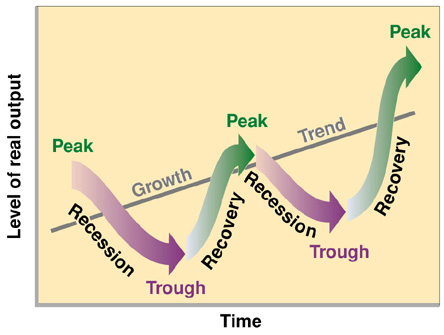
1. Graph number one is good because it depicts recession and growth are in the business cycle and it also shows you what there potential to become is if everything was perfect. So it gives a real life view as well as an artifiicial one.
2. Graph number two is an alright representation because it is sort of confusing in a sense because it does not tell you how the different parts relate to eachother, but it does tell you part of the cycle itself.
3. Graph number three is a mix of both one and two and does do a good job of representing its purpose of describing the business cycle. It shows the process that the business cycle continuously goes through on a daily basis.
-I am presenting the JC-Wiz Award for best Graph to graph number one for its outstanding representation of the business cycle and solid creativity and good looks to the naked eye.
Monday, January 3, 2011
Visual To Help On Chapter Test
I think that this visual aid will be able to help me/us on the chapter test.
Definitions:
Macroeconomics-The study of the overall aspects and workings of a national economy, such as income, output, and the interrelationship among diverse economic sectors.
GDP-Gross Domestic Product. The total market value of all final goods and services produced in a country in a given year, equal to total consumer, investment and government spending, plus the value of exports, minus the value of imports.
GNP-Gross National Product. GNP is the total value of all final goods and services produced within a nation in a particular year, plus income earned by its citizens (including income of those located abroad), minus income of non-residents located in that country.
10 Things Learned
-The process macroeconomists use to track production, income, and consumption is known as national income accounting and provides information about a country's economic activities.
-The most widely used NIPA is Gross Domestic Product.
-To actually compute GDP, economists use the output-expenditure model.
-Personal consumption expenditures include durable goods, nondurable goods, and services.
-Gross investment is the total value of all capital goods produced in a given country in one year as well as changes in the dollar value of business inventories.
-Indirect taxes are taxes included in the final price of goods and services.
-Barter transactions, housework, and do-it-yourself home repairs are examples of non-market activities.
-Illegal activities and unreported legal activities are part of the underground economy.
-A price Index is a set of statistics that allows economists to compare price over time.
-Government transfer payments are not included when calculating government purchases.
-The most widely used NIPA is Gross Domestic Product.
-To actually compute GDP, economists use the output-expenditure model.
-Personal consumption expenditures include durable goods, nondurable goods, and services.
-Gross investment is the total value of all capital goods produced in a given country in one year as well as changes in the dollar value of business inventories.
-Indirect taxes are taxes included in the final price of goods and services.
-Barter transactions, housework, and do-it-yourself home repairs are examples of non-market activities.
-Illegal activities and unreported legal activities are part of the underground economy.
-A price Index is a set of statistics that allows economists to compare price over time.
-Government transfer payments are not included when calculating government purchases.
Tuesday, December 28, 2010
Dear Editor...,
The GDP is a faulty indicator for numerouos reasons. One because different geographics have access to different materials causeing an unfair imbalance in the world of industry and the market of certain countries. Another reason is because GDP measures total output produced within a country's borders, whether produced by that country's own firms or not. A different method that could be used could possibly be GNP because that more accuratley measures a country's total profits.
4x3 Technique
GDP=PC+GI+GS+(E-I)(GDP=Private Consumption+Gross Investment+Government Spending+(Exports-Imports)
Macro Economics
I think macroeconomics will be about dealing with things bigger than we can imagine. It will have to do with the vast majority of economics not just in select towns, cities, states, or even countries, but the entire world!!!! If you ask me, it is going to be a very interesting topic to study. I am most looking forward to learning about different GDP's in comparison to eachother.
Tuesday, December 21, 2010
Essay Contest
Technology improves my life in many ways. It makes things less complicated and more fun in most situations. Without technology, many things that I do in my life would not be possible. Such as using the computer, making phone calls and even simple things like heating and cooling a house. Technology is a part of everything in this world basically. You must use it to help the economy, agriculture, creativity and many other aspects of life. Without technology, being able to sustain a natural balance in life would eventually die out fairly soon. That is how technology effects my Life.
Monday, December 20, 2010
Malcolm Video Thoughts
I thought the video that Malcolm Gladwell spoke in was out right breath-taking. He really knew what he was talking about he explained Economics in a way that many would never even think about unless you were to see his video. The main reason he was so effective in describing economics was because he related it to something that us as people can relate to. He made it easy for us to understand and thats what i think makes it the most effictive description of Economics out there. I would highly and certainly recommend it. This would be an example of Perfect Competition because not every aspect of competition is based solely on price.
Friday, December 10, 2010
Review Game
In some situations, government is forced to break up monopolies. Play this game and learn here are some laws they've used.
http://www.studystack.com/flashcard-521976
http://www.studystack.com/flashcard-521976
Thursday, December 9, 2010
Four Types Of Monopolies
Pure- An example of Pure Monopoly is PSE&G because they control their entire industry respectively.
Government- An example of Government Monopoly is the U.S. Postal Service because it is the sole provider of that specific good/service.
Technological- An example of Technological Monopoly is microsoft because of the product sold and the fact that they are the only producer of their product.
Geographic- An example of Geographic Monopoly is Florida Oranges because based on the climate, environment and available resources in that specific state, florida is the only place that can grow there respective fruit.
Government- An example of Government Monopoly is the U.S. Postal Service because it is the sole provider of that specific good/service.
Technological- An example of Technological Monopoly is microsoft because of the product sold and the fact that they are the only producer of their product.
Geographic- An example of Geographic Monopoly is Florida Oranges because based on the climate, environment and available resources in that specific state, florida is the only place that can grow there respective fruit.
Wednesday, December 8, 2010
Monopoly Split
If there was one Cartel that i would want to get rid of, then it would be the industry of online soccer vendors. There are only two maybe three of them, but it is the only place that you can get high quality and rare soccer gear in the world. They don't always sell the best of soccer equipment in retail stores so i would want to break up that Cartel. I think my family, friends and myself would benefit from this because then the soccer gear that is sold on those websites would be dispersed throughout the different retail stores throughout the country. It would help out because it would make it easier to find and retain goods related to soccer, because i could just run out to the nearest store and get it whenever i see fit.
Tuesday, December 7, 2010
Quizzes Information
Throughout the quizzes, i learned a lot. I learned that consumers benefit the most from a highly competitive market. I learned that non-price competition is when sellers compete on factors other than price. I learned that the main goal of of product differentiation and nonprice competition is to increase profits. I learned that breakfast cereals are a simple example of an oligopoly. I learned that the most common form of interdependent pricing is price leadership. I learned that a Cartel is group of companies openly organized to set prices. I learned that the Sherman Anti-Trust Act broke up the Standard Oil Company. I also learned that Interstate Commerce Commission oversaw the railroad industry. That is what i learned throughout taking the quizzes.
Friday, December 3, 2010
5 Items To Purchase
-The five items i would want to or already have purchased are a new phone, clothes, fast-food, a television, and new cleats.
: The market structure that a Cell phone would exist in is an oligopoly. There are only a few number of sellers.
: The market structure that clothes would exist in is a monopolistic competition which means that there are lots of buyers and sellers, but competition may be limited by specifci market conditions.
: The market structure that fast-food would exist in is a monopolistic competition. This means that there are many independent buyers and sellers although, competition may be limited by specific market conditions
: The market structure that a television would exist in is a monopolistic competition.
: The market structure that new cleats would exist in is an oligopoly which means there are such few sellers that the slightest change would effect basically the entire industry.
: The market structure that a Cell phone would exist in is an oligopoly. There are only a few number of sellers.
: The market structure that clothes would exist in is a monopolistic competition which means that there are lots of buyers and sellers, but competition may be limited by specifci market conditions.
: The market structure that fast-food would exist in is a monopolistic competition. This means that there are many independent buyers and sellers although, competition may be limited by specific market conditions
: The market structure that a television would exist in is a monopolistic competition.
: The market structure that new cleats would exist in is an oligopoly which means there are such few sellers that the slightest change would effect basically the entire industry.

Thursday, December 2, 2010
Intro
My name is Reece Cooke, I play soccer and im in love with my baby kaelyn. I love JC and Wiz. In my free time, i like to study, play soccer, hang with friends, hang with family, hang with my girlfriend and live life freely and smartly. I am a hard worker and i am dedicated to what i stand for and believe in. This project is for Mr. Campbells Economic Class.
Subscribe to:
Posts (Atom)